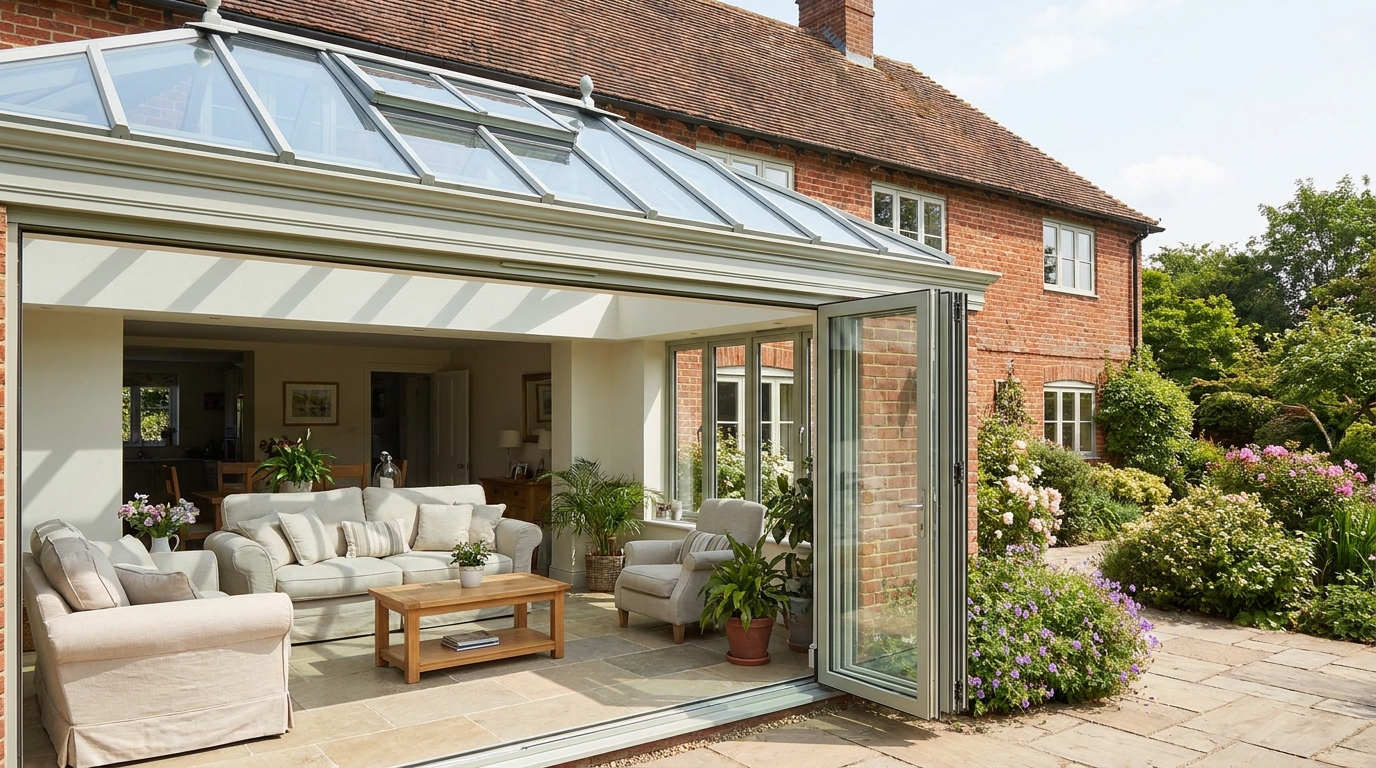
The short answer
A conservatory is lowest-cost and quickest but the most limited in comfort; an extension is the most expensive but delivers a fully habitable room; an orangery sits in the middle on all three counts. The right choice depends on budget, how the space will be used, and what planning and building regulations allow. See orangery vs conservatory and conservatory vs extension for the two-way comparisons.
The three-way comparison between a conservatory, an orangery and a full extension is the decision most homeowners are really navigating when they think about adding a glazed space. Each sits at a different point on a triangle of cost, regulatory complexity and year-round performance. A conservatory is at one corner: affordable, quick, relatively unregulated, but thermally compromised. An extension is at another: expensive, slow, fully regulated, but delivering genuine habitable space. An orangery sits somewhere in the middle on all three axes — and increasingly the “warm room” solid-roof conservatory occupies a hybrid position between orangery and traditional conservatory.
Three-way comparison at a glance
- Conservatory cost £8,000–£25,000 installed (typical)
- Orangery cost £20,000–£50,000+ installed (typical)
- Extension cost £25,000–£70,000+ installed (typical)
- Planning regs All can be PD — different rules apply to each
- Building regs Part L Conservatory can be exempt; others must comply
- Year-round comfort Extension best; orangery good; conservatory variable
The three structures compared
| Factor | Conservatory | Orangery | Extension |
|---|---|---|---|
| Typical cost | £8k–£25k | £20k–£50k+ | £25k–£70k+ |
| Build time | 2–6 weeks | 8–14 weeks | 10–20 weeks |
| Roof | Mostly glazed | Solid + lantern | Fully solid |
| Walls | Mostly glazed | Mostly solid | Fully solid |
| Planning | Often PD | Often PD (extension rules) | Often PD (extension rules) |
| Building regs Part L | Often exempt | Must comply | Must comply |
| Habitable room | No | Yes | Yes |
| Year-round comfort | Variable | Good | Excellent |
| Light quality | High (full glazing) | High (lantern) | Moderate (windows only) |
| Value added | Moderate | Good | High |
When a conservatory is the right choice
A conservatory is the right choice when: budget is the primary constraint; the space is intended as a garden room or occasional leisure space rather than a daily-use habitable room; the planning situation favours the conservatory route; or the home’s character suits a traditional glazed addition. A well-specified conservatory with solar-control glass and good ventilation is genuinely usable for the majority of the year in the UK climate. It is not the right choice if it will be the main kitchen-diner, a daily home office or a room that needs to perform identically to the main house in all weathers.
When an orangery is the right choice
An orangery is the right choice when: a year-round habitable room is the goal but the budget does not stretch to a full brick extension; the home’s character and plot suit the more substantial structure; or the connection between indoor and outdoor space matters — the orangery, with its lantern light and large doors, delivers that connection better than a solid extension. An orangery is also the right choice when the appearance of the glazed addition from the garden or street is important — the solid piers and lantern roof create a more considered architectural statement than a standard glass box.
When an extension is the right choice
An extension is the right choice when: year-round habitable performance is non-negotiable; the use case is a kitchen, bathroom, bedroom or daily working space; the budget allows the higher investment; or the property is at a price point where additional habitable floorspace adds the most value. An extension also makes sense where a solid structure is needed to match an existing part of the house — for example, extending the kitchen and matching the rear elevation of the main building. The longer build time and regulatory requirements of an extension are worth accepting when the outcome is a fully-integrated, habitable room with the same standards as the rest of the house.
Planning considerations across all three
All three structures can potentially be built under permitted development, but the rules differ. A conservatory can qualify under the specific conservatory PD category. An orangery and extension both fall under the householder extension PD rules, which have the same depth and height limits but without the specific conservatory glazing-proportion criteria. In conservation areas and on listed buildings, all three structures face more restrictions. See planning permission guide for the full detail, and always check with your local planning authority before committing to a design. This page is general information, not planning or structural advice.
Frequently asked questions
Is a conservatory or orangery cheaper?
A conservatory is typically significantly cheaper — often 40–100 % less for an equivalent footprint — because it involves less brickwork and simpler construction. See conservatory cost and orangery cost for typical ranges.
Which is better for year-round use — conservatory, orangery or extension?
An extension is the most comfortable year-round because it is fully insulated and habitable. An orangery is a good second choice with its solid walls and partly solid roof. A conservatory needs a good glass specification and heating to be used comfortably year-round.
Does an extension add more value than a conservatory?
Generally yes, because it adds legally habitable floorspace. An orangery also adds more value than a conservatory for the same reason. The gap depends on the local market and the quality of construction. See our value guide.
Which requires planning permission — conservatory, orangery or extension?
All three can often be built without planning permission under permitted development rules, subject to size, height and location. Orangeries and extensions use the same PD rules; conservatories have their own category. Always check with your local planning authority.
Sources & further reading
- Planning Portal — permitted development rules for conservatories, orangeries and single-storey extensions
- GOV.UK — Building Regulations Approved Document L, Part L exemption for conservatories and compliance for extensions
- Glass & Glazing Federation — conservatory, orangery and glazed extension construction guidance
- LABC — Local Authority Building Control guidance on orangery and extension classification and compliance
This is general information about conservatories and orangeries in the UK, not planning, structural, legal or financial advice. Costs are typical illustrations only and are not quotes for any specific project; actual prices vary with size, site conditions and your chosen installer.