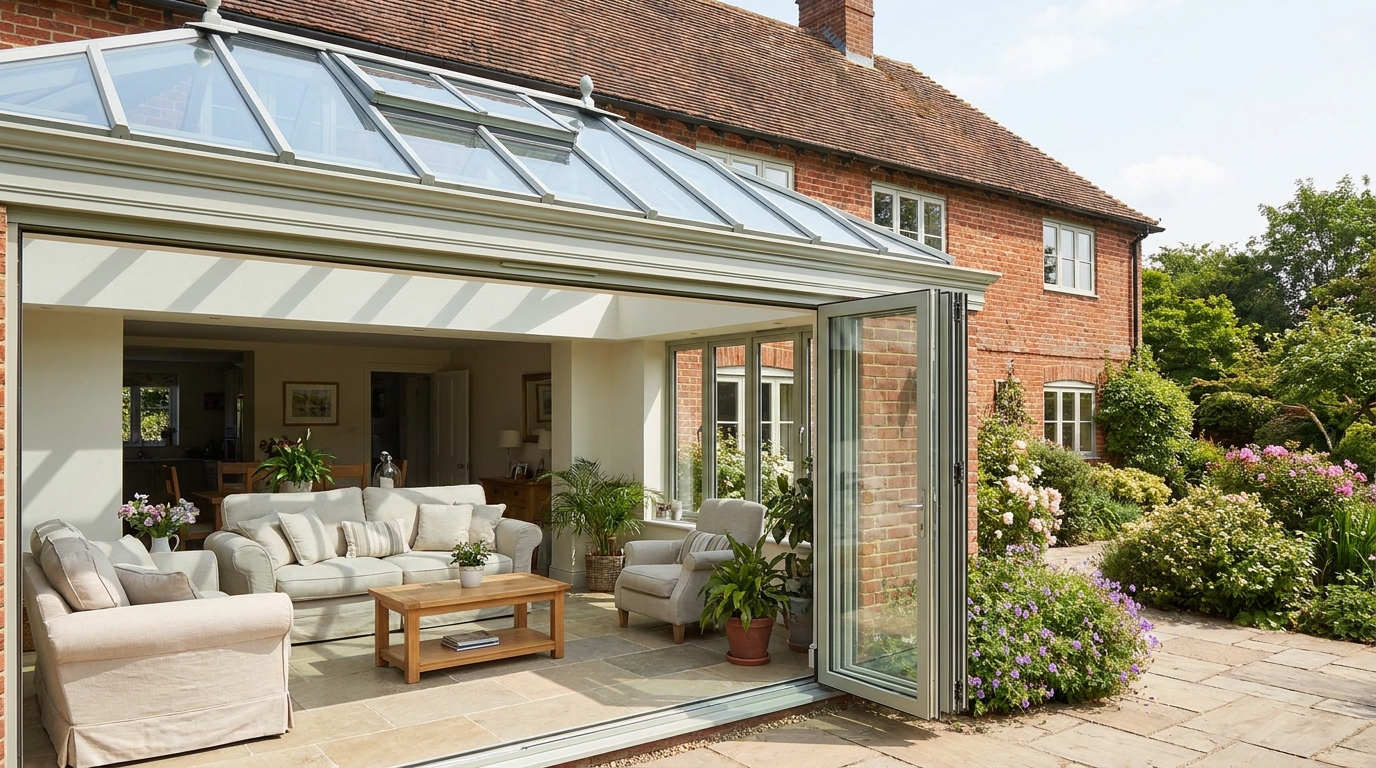
The short answer
A well-built conservatory in good condition can add 5–10 % to a property’s value, according to commonly cited UK estate agent data, but the actual uplift depends on the property type, local market and the quality of the conservatory. A poor-quality or uncomfortable conservatory can be neutral or even a negative. See conservatory cost for what you are spending and orangery vs conservatory for which adds more.
The question of whether a conservatory adds value is one of the most frequently asked by homeowners considering the investment. The honest answer is: it depends. A high-quality conservatory that is genuinely usable, well integrated with the house and in keeping with the local property market can make a home more attractive to buyers and justify a higher asking price. A cheap polycarbonate lean-to that bakes in summer and freezes in winter can be a liability — something a buyer mentally deducts from the price because they will need to upgrade or demolish it.
Value added at a glance
- Typical value uplift (well-built) 5–10 % commonly cited by estate agents
- Orangery uplift Potentially higher — adds habitable space
- Extension uplift Typically higher per £ spent than conservatory
- Negative factor Poor quality or uncomfortable conservatory
- Key condition In keeping with the property and local market
- Legal consideration FENSA certificate required at sale for glazing
What the evidence suggests
There is no official index of conservatory value uplift — RICS does not publish specific figures — but estate agent surveys consistently cite ranges of 5–10 % for a well-specified, good-condition conservatory. This translates to £15,000–£30,000 on a £300,000 home, which for a mid-range conservatory costing £12,000–£18,000 represents a reasonable return. The caveat in every such survey is “well-specified and in good condition”, because the converse — a poor conservatory — can be a neutral or negative factor. Estate agents consistently note that buyers in family-home markets respond positively to a quality conservatory because it provides additional kitchen-adjacent or garden-adjacent space, but they discount heavily for anything that looks tired, leaks, or is visibly uncomfortable to use.
When a conservatory adds most value
A conservatory is most likely to add meaningful value when:
- It is proportionate to the property — a modest conservatory on a modest home adds more relative value than an oversized one.
- It is in keeping with the architectural character — a Victorian conservatory on a Victorian terrace; a lean-to on a contemporary home.
- It has a good roof specification (glass rather than old polycarbonate) and is genuinely usable for more than two months of the year.
- It has all relevant FENSA certificates, building regulations documentation and planning records, so conveyancing is straightforward.
- The local market includes buyers who value the extra space — conservatories typically add most value in the family-home segment.
| Conservatory type | Likely value impact | Condition |
|---|---|---|
| Quality glass-roof uPVC | Positive — 5–8 % | Good condition, FENSA certified |
| Aluminium, solar-control glass | Positive — 7–10 % | High spec, year-round usable |
| Orangery (building-regs compliant) | Positive — 8–12 % | Adds habitable floorspace |
| Old polycarbonate, poor condition | Neutral or negative | Buyer sees cost to upgrade |
When a conservatory does not add value
Estate agents consistently flag circumstances where a conservatory is a drag rather than an asset. An old polycarbonate roof that has discoloured and yellowed, a leaking ridge or guttering, a cracked base, condensation in the glazing units or visible damp are all things buyers notice and price in as remediation costs. In upmarket markets, a cheap-looking conservatory can actually make the house look less premium than a well-presented garden. If the conservatory does not have a FENSA certificate or the glazing is non-compliant, it can delay or complicate conveyancing. Any buyer whose solicitor finds missing documentation at exchange may use it to renegotiate downward or, in a weak market, pull out.
Conservatory vs orangery vs extension for value
A building-regulations-compliant orangery or full extension typically adds more per pound to a property’s value than a conservatory because it adds legally habitable floorspace. Surveyors use square footage as a key metric in comparative valuations, and a habitable room counts; a conservatory exempted from Part L does not. The gap is less pronounced in markets where buyer demand for conservatories specifically is high — family home markets with garden-facing rear plots — but the structural argument for an orangery as a value investment is strong if the budget allows. See conservatory vs extension and orangery cost. This page provides general information based on publicly available UK estate agent and trade guidance; it is not a property valuation or financial advice.
Frequently asked questions
How much value does a conservatory add to a house?
Estate agent surveys commonly cite 5–10 % for a well-built conservatory in good condition, but this depends heavily on the property type, local market and the quality of the conservatory. A poor-quality structure may add nothing or be seen as a cost.
Does a conservatory count as a room?
For planning and building regulation purposes, a conservatory that is exempt from Part L is not a habitable room. An orangery or extension that meets full Part L is. This distinction affects property valuations and mortgage assessments.
Do I need to declare a conservatory when selling?
Yes. Any improvements to a property must be disclosed in the seller’s property information form. You should be able to provide FENSA certificates for any glazing and planning or building regulations documentation for the structure.
Is an orangery worth more than a conservatory on a house?
Generally yes, because it adds habitable floorspace and complies with building regulations. The premium depends on the local market and the quality of construction. See our orangery cost and orangery vs conservatory guides.
Sources & further reading
- RICS — property valuation principles and habitable floorspace guidance
- FENSA — glazing certification requirements at property sale
- Glass & Glazing Federation — conservatory quality standards and buyer-facing guidance
- LABC — Local Authority Building Control on habitable room classification and building regulations compliance
This is general information about conservatories and orangeries in the UK, not planning, structural, legal or financial advice. Costs are typical illustrations only and are not quotes for any specific project; actual prices vary with size, site conditions and your chosen installer.