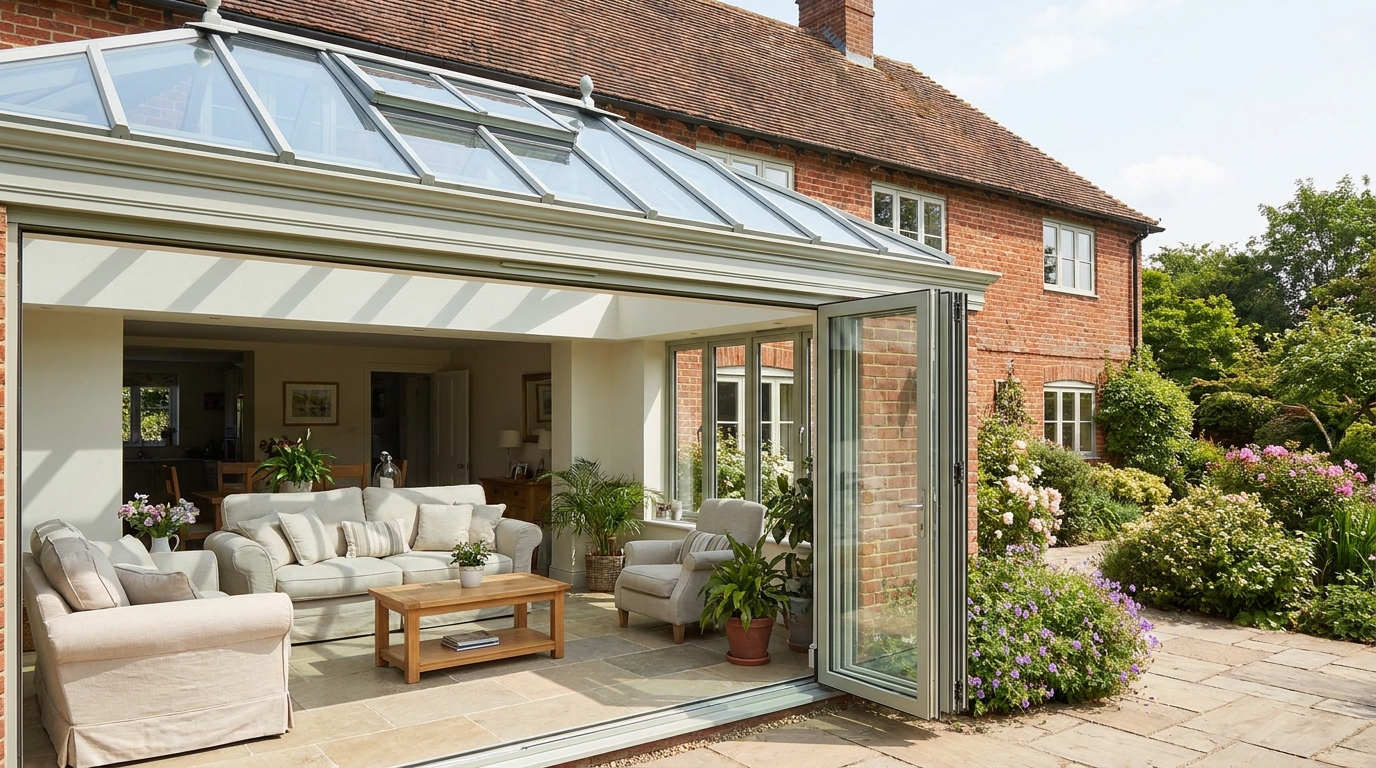
The short answer
A conservatory that is genuinely usable year-round needs: a solar-control glass roof (or solid roof) with a low U-value; adequate roof ventilation; a thermal frame; and a correctly sized heating system. South- and west-facing conservatories need more careful solar-control specification. See summer overheating and winter cold for the specific challenges.
Year-round usability is the ambition most homeowners have when they commission a conservatory, and yet many conservatories end up as seasonal spaces — too hot from May to September, too cold from November to March. The gap between ambition and outcome is almost always a specification gap rather than an inherent flaw in the concept. A conservatory can be a comfortable, much-used room in all but the most extreme UK weather, provided the right choices are made at design and build stage. This guide sets out what those choices are.
Year-round conservatory at a glance
- Roof Solar-control glass or solid — not polycarbonate
- Glass SHGC Below 0.3 for good solar control
- Roof U-value Target 1.0 or below for glass; 0.20 for solid
- Ventilation At least 5 % of floor area openable
- Heating Underfloor or correctly sized radiator circuit
- Orientation South/west facing need most careful spec
The roof specification is the most critical decision
If there is one thing that determines whether a conservatory is usable year-round, it is the roof specification. A polycarbonate roof is a non-starter for year-round use: it will be roasting in summer and cold in winter. Even standard double-glazed glass without solar-control coatings will overheat significantly on south and west-facing conservatories. For year-round comfort, the roof glazing should have: a Solar Heat Gain Coefficient (SHGC) below 0.3 to control summer heat gain; a U-value of 1.0 W/m²K or below to limit winter heat loss; and argon fill and a low-emissivity coating as standard. Self-cleaning glass is also worth specifying for the outer pane, since conservatory roofs are difficult to clean manually and dirty glass reduces both the solar-control performance and the light quality. See conservatory roof options for a full comparison of glass types and solid roof alternatives.
Orientation and its impact on specification
Orientation is the single biggest predictor of how difficult year-round use will be. A north-facing conservatory has relatively little solar gain and its main challenge is winter heat loss — manageable with a good glass spec and heating. A south-facing conservatory collects maximum solar radiation and faces the most serious overheating risk; it needs the strongest solar-control specification and the best ventilation. West-facing conservatories have afternoon and evening sun, which is the most uncomfortable pattern because the room heats up through the day and peaks at the warmest time of the afternoon. East-facing conservatories have morning sun and are generally easier to manage.
| Orientation | Main challenge | Key specification |
|---|---|---|
| North-facing | Winter cold, less light | Low U-value glass, heating |
| South-facing | Summer overheating | Solar-control glass (SHGC <0.25), max ventilation |
| East-facing | Morning glare, manageable | Good glass spec, ventilation |
| West-facing | Afternoon heat gain | Strong solar-control, external blinds |
Ventilation — non-negotiable for summer
No matter how good the glass specification, ventilation is essential for summer comfort. The Glass & Glazing Federation recommends that openable ventilation represents at least 5 % of the floor area. For a 20 m² conservatory that means at least 1 m² of openable ventilation — achieved through a combination of roof vents (ideally at the ridge or high on the rear slope) and ground-level opening windows or doors. Roof ventilation is more effective than ground-level only because hot air rises to the roof apex and can exit directly. If specifying a new conservatory, confirm that roof vents are included in the design and that they are positioned for effective cross-ventilation rather than just ticking a box. Automatic roof vents (which open when the internal temperature exceeds a set point) are available and are a valuable addition to south and west-facing conservatories.
Heating for winter use
A well-glazed conservatory still loses heat faster than an insulated room, so heating provision needs to be correctly sized. Underfloor heating is the most comfortable option and is much easier to install during construction than retrospectively. For a medium conservatory (15–20 m²) with a good glass spec, a wet UFH circuit or a 1.5–2.5 kW electric UFH mat is typically adequate. If extending the main central heating to the conservatory, have the circuit sized by a qualified heating engineer — undersizing the radiator leaves the space cold even on moderate winter days. Remember that permanently connecting the conservatory to the central heating system may remove the Part L building regulations exemption; check with building control. See are conservatories cold in winter for more on heating options.
The solid roof option
If absolute year-round comfort is the priority and the cost is acceptable, a solid tiled roof (or an orangery with a lantern) is the most reliable solution. A solid roof eliminates the solar gain problem in summer, reduces winter heat loss to extension-equivalent levels, and removes the noise issue in rain. The trade-off is the loss of the overhead glazed light and the change in legal classification. For those who would genuinely use the conservatory 12 months of the year and regard the loss of the glazed sky view as acceptable, a solid roof converts the space into something closer to a proper room — and makes the heating and cooling challenges much more manageable. See conservatory vs orangery vs extension for the broader comparison. This page is general information, not a technical specification; always confirm specific glass, ventilation and heating specifications with a qualified installer.
Frequently asked questions
What type of conservatory is best for year-round use?
A well-specified glass-roof conservatory with solar-control glazing (SHGC below 0.3), good ventilation and heating can be comfortable year-round. A solid roof is even better thermally. An orangery with solid walls and a lantern roof is the premium solution for year-round habitability.
What glass is best for a year-round conservatory?
Solar-control low-emissivity glass with an SHGC below 0.3 and a U-value of 1.0 or below. Self-cleaning coating on the outer pane is also recommended for a roof. Ask installers for the specific figures, not just brand names.
Can a uPVC conservatory be used year-round?
Yes, if it is correctly specified — with solar-control glass, adequate ventilation and a suitable heating system. The frame material (uPVC vs aluminium) is less critical for year-round comfort than the roof glazing and ventilation specification.
Does orientation affect how comfortable a conservatory is?
Significantly. South and west-facing conservatories face the most serious overheating challenge and need the most careful solar-control and ventilation specification. North-facing conservatories are cooler in summer but need more heating in winter.
Sources & further reading
- Glass & Glazing Federation — conservatory ventilation guidance (5 % floor area rule) and solar-control glazing standards
- FENSA — glazing energy performance ratings and solar heat gain coefficient guidance
- GOV.UK — Building Regulations Approved Document L, conservatory glazing and thermal performance standards
- LABC — Local Authority Building Control guidance on conservatory heating, building regulations and solid roof conversions
This is general information about conservatories and orangeries in the UK, not planning, structural, legal or financial advice. Costs are typical illustrations only and are not quotes for any specific project; actual prices vary with size, site conditions and your chosen installer.