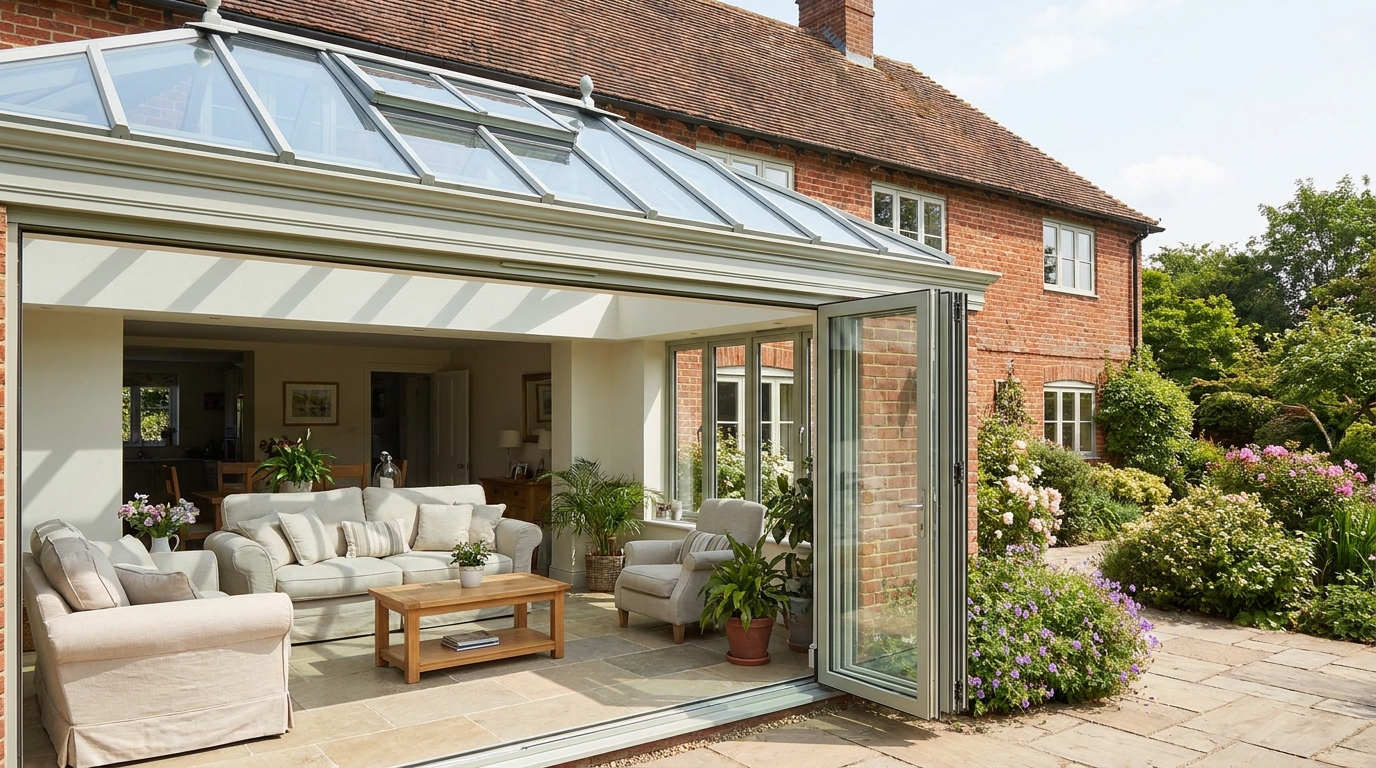
The short answer
A conservatory is typically cheaper and quicker to build and often requires no planning permission, but it struggles with temperature extremes and is legally not a habitable room. An extension costs more and faces more regulatory hurdles, but delivers a fully habitable space with the same building standards as the rest of the house. The right choice depends on budget, intended use and the character of your home. See orangery vs conservatory and conservatory cost for related guidance.
The debate between a conservatory and a full extension is one of the first decisions homeowners face when thinking about adding space. It is partly a money question — extensions cost considerably more — but it is also about how the space will be used, how it needs to perform thermally, and what the planning situation allows. Neither option is universally better; the right answer depends on a combination of budget, site, planning constraints and the ambition for the room.
Conservatory vs extension at a glance
- Conservatory typical cost £8,000–£25,000 depending on size & spec
- Extension typical cost £20,000–£60,000+ for single storey
- Planning Conservatory often PD; extension PD within limits
- Building regs Conservatory can be exempt; extension must comply
- Year-round use Extension far better; conservatory needs good spec
- Legal status Conservatory not habitable room; extension is
Cost comparison
Cost is usually the deciding factor and the gap is substantial. A uPVC conservatory in the range of 15–20 m² typically costs £8,000–£20,000 installed, while an aluminium conservatory of the same size might run to £15,000–£28,000. A single-storey brick extension of equivalent size typically costs £25,000–£50,000 or more, depending heavily on the structural specification, whether it requires steel beams, the quality of the finishes, and whether kitchen or utility plumbing is involved. The gap narrows when you factor in that a full extension delivers a room that requires no caveats about temperature or legal status — but for many budgets, the lower cost of a conservatory is simply decisive. See conservatory cost for a detailed breakdown of what drives conservatory pricing.
Planning permission and permitted development
Both a conservatory and a single-storey extension can often be built under permitted development without planning permission, but the specific rules differ. A conservatory has its own category in PD rules and can sometimes qualify where an extension of the same size would not, because the glazed envelope is treated differently. However, both must meet the overall 50 % curtilage rule and single-storey height and depth limits. Extensions have a prior approval route for larger structures (up to 8 m rear extension for detached houses) through the Householder Application Service. Properties in conservation areas, Article 4 areas or listed buildings face additional constraints either way. See planning permission for a conservatory for the detail.
| Conservatory | Extension | |
|---|---|---|
| Typical cost (15–20 m²) | £8,000–£25,000 | £25,000–£55,000+ |
| Build time | 2–6 weeks | 8–20 weeks |
| Planning permission | Often PD | Often PD (within limits) |
| Building regs Part L | Can be exempt | Must comply |
| Habitable room? | No (legally) | Yes |
| Year-round comfort | Variable | Same as main house |
| Resale value added | Moderate | Generally higher |
Building regulations — a significant difference
A conservatory that meets the glazing proportions, size and separation conditions can be entirely exempt from Building Regulations Part L (energy efficiency). That speeds up construction, reduces cost and simplifies the process. An extension, however, must fully comply with current Part L standards for walls, floors, roof and glazing. That compliance adds cost but also delivers a thermally excellent structure. The building regulations difference also affects the legal status of the room: a conservatory that is exempt from Part L cannot be legally counted as a habitable room in planning terms, which is relevant to property valuations, mortgages and certain planning applications. An extension is treated as a habitable room from the outset.
Year-round comfort — the practical reality
This is where the two options diverge most in practice. A conservatory with a glass roof and mostly glazed walls is subject to significant solar gain in summer and rapid heat loss in winter. Modern solar-control glass, good ventilation and a well-designed heating circuit can make a conservatory comfortable for most of the year, but it will rarely match the all-year consistency of an insulated extension. If the room’s purpose is a dining room, a kitchen extension or a home office used daily in all weathers, an extension — or at minimum an orangery with its solid walls and partly solid roof — is the more honest recommendation for comfort. See are conservatories too hot in summer and are conservatories cold in winter for the detail.
Which adds more value to a property?
A well-built extension in keeping with the property almost always adds more measurable value per pound spent than a conservatory, because it is a fully habitable room counted in the floorspace. However, both can add value when done well and to a standard appropriate to the property. A conservatory on a mid-range home adds useful selling appeal, particularly for families wanting garden access. The key factor for either is build quality — a poorly built, leaking or uncomfortable structure can be a neutral factor at best. See does a conservatory add value for more detail. This page is general information, not structural, planning or financial advice.
Frequently asked questions
Is a conservatory cheaper than an extension?
Typically significantly so — a conservatory can cost around a third to half as much as an equivalent extension. The trade-off is in thermal performance, legal status and year-round usability.
Do I need planning permission for a conservatory or extension?
Both can often be built under permitted development without planning permission, subject to size, height and location rules. Properties in conservation areas or listed buildings always need to check. See our planning permission guide.
Which adds more value — conservatory or extension?
A well-built extension generally adds more measurable value because it increases habitable floorspace. A conservatory adds useful appeal and can add value, particularly on family homes, but typically less per pound spent. See our value guide.
How long does each take to build?
A conservatory typically takes 2–6 weeks from groundworks to completion. An extension usually takes 8–20 weeks depending on size, structural complexity and the builder’s programme.
Sources & further reading
- Planning Portal — permitted development rules for conservatories and extensions, size thresholds and prior approval
- GOV.UK — Building Regulations Approved Document L, Part L conservatory exemption and extension compliance
- LABC — Local Authority Building Control guidance on habitable rooms, extensions and conservatory classifications
- Glass & Glazing Federation — conservatory energy performance, frame ratings and thermal separation guidance
This is general information about conservatories and orangeries in the UK, not planning, structural, legal or financial advice. Costs are typical illustrations only and are not quotes for any specific project; actual prices vary with size, site conditions and your chosen installer.