The short answer
The main conservatory types in the UK are Victorian (multi-faceted bay front), Edwardian (square or rectangular), lean-to (mono-pitch, sometimes called a sunroom), Gable-ended (a vertical front wall), P-shaped (combining two shapes) and T-shaped. The style affects the cost, the amount of usable floor space and whether it suits your home’s character. See what is a conservatory for the planning and building regulation context that applies to all types.
Conservatory styles in the UK have evolved over a hundred and fifty years, but the basic types available today are still largely defined by their Victorian and Edwardian origins. The choice of style is partly aesthetic — Victorian suits period homes, lean-to suits modern bungalows — but it also has practical consequences: a lean-to is the most space-efficient option against a narrow plot boundary, while a Victorian bay with its angled walls eats into floor space. Understanding the types before approaching an installer prevents you from being sold a style that does not suit your home or your garden.
Conservatory types at a glance
- Victorian Multi-faceted bay front, ornate ridge, suits period homes
- Edwardian Square/rectangular, maximum floor space per £
- Lean-to / Sunroom Mono-pitch, suits narrow plots and bungalows
- Gable-ended Vertical front wall, high ceiling, large feel
- P-shaped Combines Victorian bay + lean-to, suits large homes
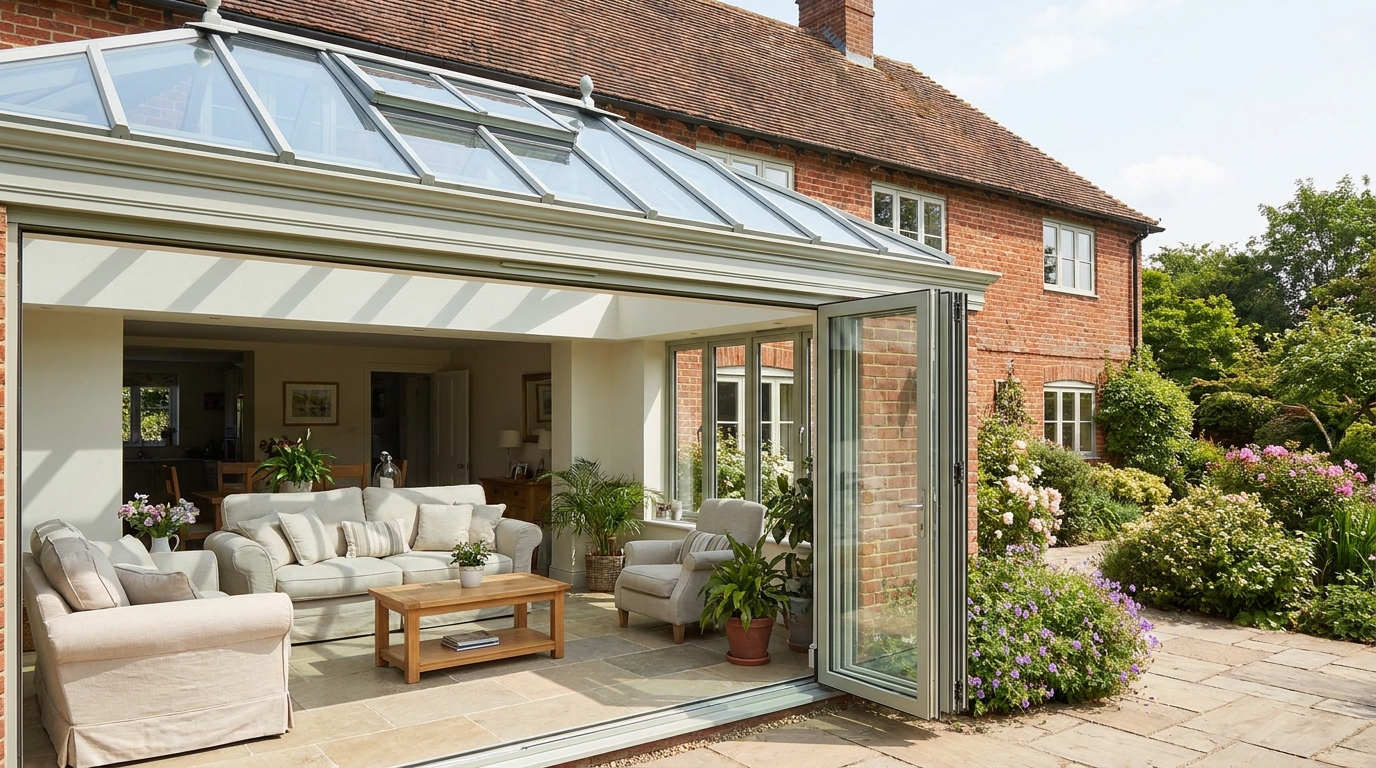
- Orangery Mostly solid walls, lantern roof — see guide
Victorian conservatory
The Victorian style is the most recognisable conservatory in the UK and takes its proportions from the glass and iron structures built during the Victorian era. It has a three- or five-faceted bay front — angled sides rather than straight walls — topped by a steeply pitched ridge roof and typically decorated with a roof cresting finial. The angled front gives it a distinctive, period feel that suits Victorian and Edwardian terraces and semi-detached homes. The trade-off is usable floor space: the angled walls reduce the internal footprint compared with a same-width rectangular conservatory. Victorian styles are available in all frame materials but look most authentic in white uPVC or timber on period homes.
Edwardian conservatory
The Edwardian (also called Georgian or square-ended) conservatory has straight walls on all four sides, giving a square or rectangular footprint with maximum usable floor space for a given frame width. The roof is a conventional pitched or hipped ridge. Because the form is simple and regular, Edwardian conservatories are generally slightly cheaper per square metre than Victorian ones and are popular choices where the internal space is the priority — for dining rooms, playrooms or garden rooms. The clean lines suit both period and modern homes.
Lean-to conservatory
A lean-to (sometimes marketed as a sunroom or Mediterranean-style conservatory) has a mono-pitch roof that slopes away from the house wall. It is the simplest and typically the most affordable type, and it works particularly well on bungalows and in plots where height is constrained by neighbouring properties or planning rules. A lean-to also suits modern homes and flat-roofed extensions where a pitched ridge would look out of place. The lower roof pitch can limit the internal height at the front, but for a compact glazed room that floods with light it is an efficient choice. See conservatory cost for typical lean-to prices.
| Type | Best for | Relative cost | Floor space |
|---|---|---|---|
| Victorian | Period homes, character | Mid–high | Moderate (angled walls) |
| Edwardian | Space efficiency | Mid | High |
| Lean-to | Bungalows, tight plots | Lower | Good |
| Gable-ended | High ceiling, grand feel | Mid–high | Good |
| P-shaped | Large homes, two zones | Higher | Very high |
Gable-ended conservatory
A gable-ended conservatory has a vertical glazed front wall rather than the sloped roof line of a Victorian or Edwardian. The gable rises to the ridge, giving a dramatic, high-vaulted interior feel and a much more imposing external presence. The additional height and the engineering required to support the gable make it more expensive than a standard Edwardian, but for large detached homes where a grand garden room is the aspiration, the gable-ended design delivers a sense of space and light that the other types cannot match.
P-shaped and T-shaped conservatories
A P-shaped conservatory combines a Victorian bay section at one end with a lean-to section running alongside the house, creating a larger overall footprint and two distinct zones — often used as a sitting area and a dining area. A T-shape does the same thing perpendicularly. Both types suit substantial homes where a single-shape conservatory would be either too small or look out of proportion. They are more expensive because they require more materials and a more complex junction between the two roof sections. Planning permission is more likely to be required because the combined structure often exceeds standard permitted development size limits; see planning permission for the thresholds.
Roof options across all types
Whatever the structural style, you can typically choose from polycarbonate, glass or a solid (tiled) roof. Polycarbonate is the lowest-cost but the least comfortable in temperature extremes. Modern solar-control glass is the current standard and dramatically improves on older glass roofs. A solid roof — which changes the legal classification of the structure — is increasingly popular because it eliminates the noise and temperature issues associated with glass. See conservatory roof options for a full comparison. Whatever type and roof you choose, make sure the installer is FENSA-registered if any replacement glazing is involved, and obtain a written specification for the frame energy ratings. This page is general information and not structural or planning advice.
Frequently asked questions
Which type of conservatory is most popular in the UK?
The Edwardian (rectangular) style is probably the most widely installed because it delivers the most usable floor space per pound. Victorian is the most iconic-looking, particularly on period homes.
What is a lean-to conservatory?
A lean-to has a mono-pitch roof that slopes away from the house. It is the simplest and most affordable type, and it works particularly well on bungalows and narrow plots. Also called a sunroom or Mediterranean-style conservatory.
Which conservatory type is lowest-cost?
A lean-to conservatory is typically the most affordable because it is the simplest construction. Costs vary considerably by size, frame material and roof type — see our conservatory cost guide for typical ranges.
What is a P-shaped conservatory?
A P-shaped conservatory combines a Victorian bay section with a lean-to section running alongside the house, creating a larger L-shaped footprint with two distinct zones. It suits larger homes but typically exceeds basic permitted development size limits.
Sources & further reading
- Glass & Glazing Federation — UK conservatory style guide, frame materials and glazing standards
- FENSA — Fenestration Self-Assessment Scheme installer registration and glazing compliance
- Planning Portal — permitted development rules and size thresholds for conservatory additions
- LABC — Local Authority Building Control guidance on conservatory types and building regulations
This is general information about conservatories and orangeries in the UK, not planning, structural, legal or financial advice. Costs are typical illustrations only and are not quotes for any specific project; actual prices vary with size, site conditions and your chosen installer.